Roasting Mastery: From Green Bean to Perfect Cup at Hacienda Iluminada
Beautiful Day Everyone!
We are so proud to deliver YOU the best specialty Puerto Rican coffee, and a big contributor for this is our "on-farm roasting." It allows us to control every step it is truly a farm-to-cup of coffee. Where we combine freshness, flavor, and sustainability all together. We will show YOU our step by step process from green beans to roasted coffee, and you'll see why it helps the environment and how it makes exceptional specialty coffee.
-If it’s good for EARTH it’s GOOD for YOU
Select & Prep the Green Coffee
What we do: Sort by variety and lot, remove defects, and record moisture content (ideal ~10–12%) and density (how tightly packed the cells are).
Science in short: Think of a coffee bean as a tiny, dense sponge. Moisture content is how much water is inside that sponge; it determines how heat moves during roasting. If the sponge is too wet, the heat has to first evaporate the water before it can actually "cook" the bean, which can lead to a long, uneven roast. Density is how tightly the cells are packed. Denser coffee beans are harder and absorb heat more slowly, but also more evenly, like a solid piece of metal. This slow, steady heat transfer helps develop complex flavors without burning the outside.
Environmental win: Careful sorting means fewer wasted batches and less energy used correcting flawed roasts. Roasting a uniform batch of coffee beans is like baking with a perfect recipe, you get it right the first time.
Taste win: Uniform coffee beans, makes an even roast, which means a cleaner flavor profile and higher scores in a cupping session, the professional way we taste and evaluate coffee.
Set the Roaster: Heat, Airflow, Drum Speed
What we do: Choose the charge temperature (the starting temperature of the roaster's drum), set airflow (how much hot air moves through the roaster), and drum speed (how fast the coffee beans tumble).
Science in short: Roasting uses a combination of three types of heat transfer: conduction (heat from the hot metal drum directly touching the coffee beans), convection (heat from the hot air moving around the coffee beans), and a little radiation (heat waves, like what you feel from a fireplace). Balancing these three types of heat transfer is crucial for a smooth and controlled Rate of Rise (RoR), which is how fast the coffee bean's temperature climbs. A sudden, uncontrolled rise can "damage" the outside of the coffee bean, while a slow, stalled roast can lead to "baked" flavors.
Environmental win: When we have our settings "dialed-in" for a specific roast it's like a finely tuned engine. This precision reduces fuel use by not having to overshoot the temperature, and the need to re-roast an entire batch.
Taste win: A predictable and controlled heat transfer builds repeatable, consistent flavor in every single batch we roast.

Phase One — Drying (Endothermic)
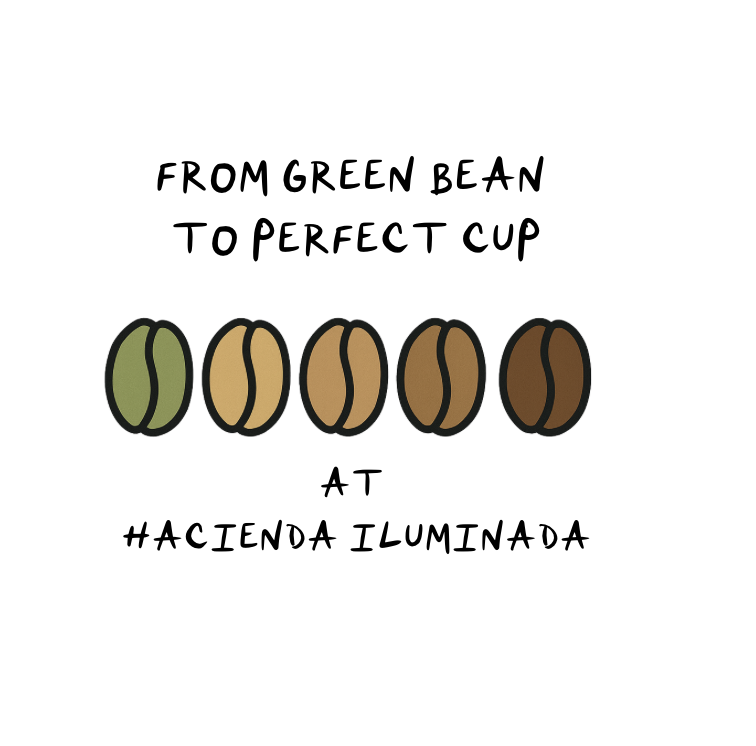
What we do: From room temp to about 160 °C (320 °F), the coffee beans soak up heat and the internal water evaporates. The freshly picked coffee beans change color from green to yellow.
Science in short: This is an endothermic phase, which means the coffee beans are absorbing a lot of energy. Specifically, the heat needed to evaporate the water inside them. Think of how a pot of water on a stove stays at 100 °C until all the water boils away. Similarly, the coffee bean's temperature stalls as it uses energy to release its moisture as water vapor. Lowering the water activity (aw) prepares the bean for the browning reactions that are about to happen.
Environmental win: A steady, slow drying phase saves gas or electricity compared to a "hard charge" (blasting the coffee beans with high heat at the start), which is not the best way to heat up coffee beans and often requires more energy to cool down later.
Taste win: Proper drying prevents undesirable "baked" or "grassy" notes and sets up the coffee beans for an even, beautiful browning in the next phase.
Phase Two — Browning (Maillard + Early Caramelization)
What we do: From about 160–190 °C (320–374 °F), incredible aromas start to bloom and the coffee beans begin to turn brown.
Science in short: This is where the magic happens! The Maillard reaction is a complex chemical process where amino acids (the building blocks of proteins) react with reducing sugars to form hundreds of new flavor and color compounds called melanoidins. These are the same compounds that make toast and seared steak brown and delicious. At the same time, caramelization begins, which is a different reaction where sugars break down on their own, creating sweeter and nutty flavors.
Chemistry shout-outs:
Sucrose (the main sugar in green coffee) begins to caramelize, giving the coffee its distinct sweetness.
Chlorogenic acids (CGAs), a group of compounds that contribute to acidity and some bitterness, start to break down. If you break them down too much (by roasting too dark), they can create caffeic acid and quinic acid, leading to a harsher, more bitter taste.
Trigonelline, a compound in coffee, starts to break down into nicotinic acid (vitamin B3), which adds pleasant roast aromas and can contribute to the body of the coffee.
Environmental win: Tight timing in this phase is key. It helps us avoid overshooting our target temperature and wasting energy on corrections.
Taste win: This is the most important phase for building the coffee's body, sweetness, and complexity.
First Crack — The Turning Point
What we do: Around 196–204 °C (385–399 °F), the coffee beans audibly "pop," marking a major physical and chemical change. We then begin the development phase.
Science in short: The "first crack" is a physical event caused by the build-up of water vapor and CO₂ (carbon dioxide) inside the bean. The pressure gets so high that it fractures the coffee's cell walls, causing the popping sound. After this, we enter the development phase. The Development Time Ratio (DTR) is the percentage of the total roast time that takes place after the first crack. A shorter DTR means a lighter, brighter coffee, while a longer DTR builds sweetness and body.
Environmental win: On-farm, small-batch control means we can stop the roast exactly where we need to, preventing waste from "missing the drop" (not stopping the roast at the right time) and having to throw out a whole batch.
Taste win: Adjusting the DTR allows us to fine-tune the flavor, we can choose to highlight a coffee's bright fruitiness or develop dark chocolate and caramel notes.
Development & Second Crack: The Art of a Balanced Medium Roast
What we do: After the first crack, we enter the crucial development phase, where we carefully build the final flavor. For our medium roasts, we precisely control this stage and then "drop" the coffee beans into the cooler. We stop just before the aggressive sound of second crack, which would signal a darker roast.
Science in short: During development, the coffee beans undergo pyrolysis, a heat-driven breakdown that generates complex new aromas called volatile aromatics. These include pyrazines (nutty and roasty notes) and furans and aldehydes(caramel and fruity scents). Second crack is a more intense popping sound that happens when the coffee beans' internal structure breaks down aggressively. This stage burns away delicate flavors and makes the coffee taste more like the roast itself, rather than its unique origin.
Environmental win: By stopping the roast at a targeted end point, we avoid over-roasting entire batches, which saves energy and prevents waste.
Taste win: This precision allows us to develop rich sweetness and body while preserving the clear, unique notes of our coffee. By avoiding second crack, we ensure you taste the distinct citrus, dark chocolate, and tropical tones of Hacienda Iluminada.

Rapid Cooling & Chaff Capture
What we do: We use powerful air to pull the heat out of the coffee beans in under four minutes and collect the chaff (the thin, paper-like husk that comes off the coffee bean).
Science in short: Quick cooling is essential to halt the chemical reactions in the coffee beans. Without rapid cooling, the coffee would continue to cook, leading to a smoky or "baked" flavor. It's like taking a cake out of a hot oven and leaving it on the counter; it will continue to cook. Rapid cooling "freezes" the flavors right where we want them.
Environmental win: The captured chaff is a valuable byproduct. Back on the farm, we compost it to enrich the soil, returning nutrients to the land. Some of it may even be used as fuel for bio-mulch. This is a perfect example of a closed-loop system, where waste from one part of the process becomes a resource for another.
Taste win: This step prevents "stalling" and any smoky or burnt aftertastes, ensuring a clean cup of coffee.
Quality Control on the Farm
What we do: We record roast curves, measure Agtron color (a standard "how dark is it" number), re-check moisture, and cup every single batch.
Science in short: The Agtron color reading is a standardized way to measure the roast degree, and it's a great tool for consistency. By matching the color reading with our roast curve data, we can ensure that a profile we roasted yesterday tastes the same as a profile roasted today.
Environmental win: On-site quality control eliminates the need to ship coffee to a distant lab for analysis, reducing transportation emissions and the risk of having to re-roast a batch due to a "missed" profile.
Taste win: Consistency is king. You can trust that your favorite profile from Hacienda Iluminada will taste the same every single time.
Stop waiting! Step into our fields, our roastery, and our story. Tour spots available now! tap on link below
If it’s GOOD for earth, it is GOOD FOR YOU!
Freshness Management: Degassing, Packaging, Storage
What we do: We let the coffee rest so CO₂ can escape, then pack it in one-way valve bags with low-oxygen headspace. We store it in a cool, dry place.
Science in short: Immediately after roasting, coffee releases a lot of CO₂ for several days in a process called degassing. If you brew coffee too soon, the excess gas can disrupt the water-to-coffee contact, leading to an uneven extraction. Over time, the coffee stales as its lipids (fats) and aroma compounds oxidize and break down. The one-way valve on our bags allows the CO₂ to escape without letting oxygen in, which slows down the staling process.
Environmental win: Roasting on the farm reduces extra shipping legs between the producer, roaster, and coffee shops. Small batches cut waste from stale inventory because we only roast what is needed, and our coffee reaches you at its peak freshness.
Taste win: You get to enjoy the coffee at its peak aromatics and sweetness, right after its ideal rest period.
Roast Profile Development: Designing Unique Flavors
What we do: We build unique roast profiles for each lot of Hacienda Iluminada coffee using controlled Rate of Rise (RoR), airflow, and Development Time Ratio (DTR).
Science in short: A gentle and steady RoR, which is simply how fast the coffee beans's temperature climb, is our goal. This avoids a "stall" (where the temperature flattens and the flavor goes flat) or a "flick" (a sudden temperature spike that can create a harsh taste). By carefully controlling these variables, we bring out the best in each coffee bean.
Environmental win: Creating a "first-time-right" profile means fewer test batches and less energy wasted.
Taste win: We can tailor roasts to highlight specific notes, whether it's a bright and fruity profile for a pour-over or a deeper, chocolatey profile for espresso.

The Hacienda Iluminada Difference
Roasting on our farm provides both environmental and flavor benefits. We shorten the supply chain, reduce fuel use, and return composable waste to the soil. We also make sure that everyone who drinks our coffee can taste exactly where it came from. The result is a cup of coffee that will leave you speechless the moment you try it.
Small-Batch Roasting Benefits
Roasting in small batches allows us to be precise and efficient. We can:
Roast to order, which means minimal overproduction and waste.
Get faster feedback from our farm team to the roaster and to the cup.
Easily match the roast to the unique characteristics of our micro-lots (very small, specific batches of coffee) and various processing styles (like washed, honey, or natural).
Result: Less waste, lower energy consumption per coffee bag, and flavorful cup of specialty coffee for you.
Roaster Education Programs (On-Site)
At our on-site roasting facility, we teach the next generation of coffee professionals the science behind great coffee, including:
The principles of heat transfer (conduction, convection, radiation) with live roast curves.
How the Maillard reaction and caramelization chemically shape flavor.
How to read first crack and use tools like the Agtron to ensure consistency.
Sensory cupping to link specific profile changes to a physical taste experience.
Why it matters: Skilled roasters make fewer mistakes and have a deeper understanding of the process. This translates directly to conserving energy and elevating the quality of every single harvest.
Why On-Farm Roasting Helps the Earth
Shorter Supply Chain: By roasting and selling on-site or to a local network, we eliminate significant transport steps, reducing our carbon footprint.
Precision = Efficiency: Our accurate profiles cut fuel use and reduce the need for re-roasting, saving energy.
Byproducts to Soil: Chaff and other byproducts are returned as compost, creating a regenerative cycle that improves the farm's health.
Less Waste: Small batches align production with demand, so fewer stale bags are discarded.
Higher Value at Origin: Roasting adds value to the coffee, and by doing it here, more of that value stays in the local community, funding sustainable farming practices like our regenerative farming, closed-loop water systems, and agroforestry.
What You'll Taste: Expect lively acids like citric acid and malic acid in lighter roasts, brown-sugar sweetness from caramelized sucrose, clean cocoa depth from balanced melanoidins, and a bouquet of volatile aromatics (floral, nutty, tropical) unique to Hacienda Iluminada.
We hope to see YOU SOON!
Experience the Best! Visit Puerto Rico’s Premier Coffee Farm!
Come see the Maricao Mountains for yourself. Walk through volcanic soil, listen to the springs that feed the farm, and taste coffee grown with integrity. Whether you’re here for a tour or to take home a bag, Hacienda Iluminada offers a taste of Puerto Rico you’ll never forget.
From our hands on Hacienda Iluminada to your cup, 787 Coffee is on a mission to redefine what it means to drink Puerto Rican coffee.
We grow every single bean ourselves.
We practice real sustainable farming—no greenwashing, just love for the land.
Every sip you take supports local farmers, protects our forests, and keeps our coffee legacy alive for the next generation.
Ready for the trip of a lifetime? Come to Maricao. Walk the fields. Smell the fresh-roasted beans. Feel the heartbeat of Puerto Rico in every single cup.
👉 Ready to taste the tradition? Book your unforgettable Hacienda Iluminada coffee tour today at HaciendaIluminada.com!